

IFRS 18 is effective from 1 January 2027, but preparation starts now.
IFRS 18 Presentation and Disclosure in Financial Statements (“IFRS 18”) is effective from 1 January 2027, with earlier application permitted. IFRS 18 replaces IAS 1 Presentation of Financial Statements, but does not consider all aspects of IAS 1. Instead, it focuses on the statement of profit or loss. Categories for the profit or loss are introduced, stricter rules around subtotals apply, presentation changes and more disclosures are required. As such, the new IFRS will also have an impact your reporting structures, systems and processes.
WHAT CHANGES WITH IFRS 18?
A. Five new categories in the income statement presentation
The presentation of items in the income statement presentation should follow your business activities. Unless your company’s main activity is investing in associates, joint ventures and unconsolidated subsidiaries or providing finance to customers, this is straightforward and the basis of this article.
IFRS 18 introduces a new, mandatory classification of the income statement into five categories:
- Category 1 – Operating: income and expenses from your main business activities (or income and expenses that are not classified in one of the other categories). This includes your revenue, cost of sales and sales, general and administrative expenses.
-
Category 2 – Investing: income (and expenses) generated from investments made independent of the entity’s main business activities. This includes interest on cash and cash equivalents and the result from associates and joint ventures.
-
Category 3 – Financing: expenses (and income) to fund the main business activities and/or investing activities. This includes interest expense of liabilities.
-
Category 4 – Income taxes: your current and deferred tax expense including related foreign exchange differences.
-
Category 5 – Discontinued operations: income derived from operations that will be discontinued and any impairments on the related asset held for sale.
B. Required totals and subtotals in the profit or loss
The following totals and subtotals are now mandatory:
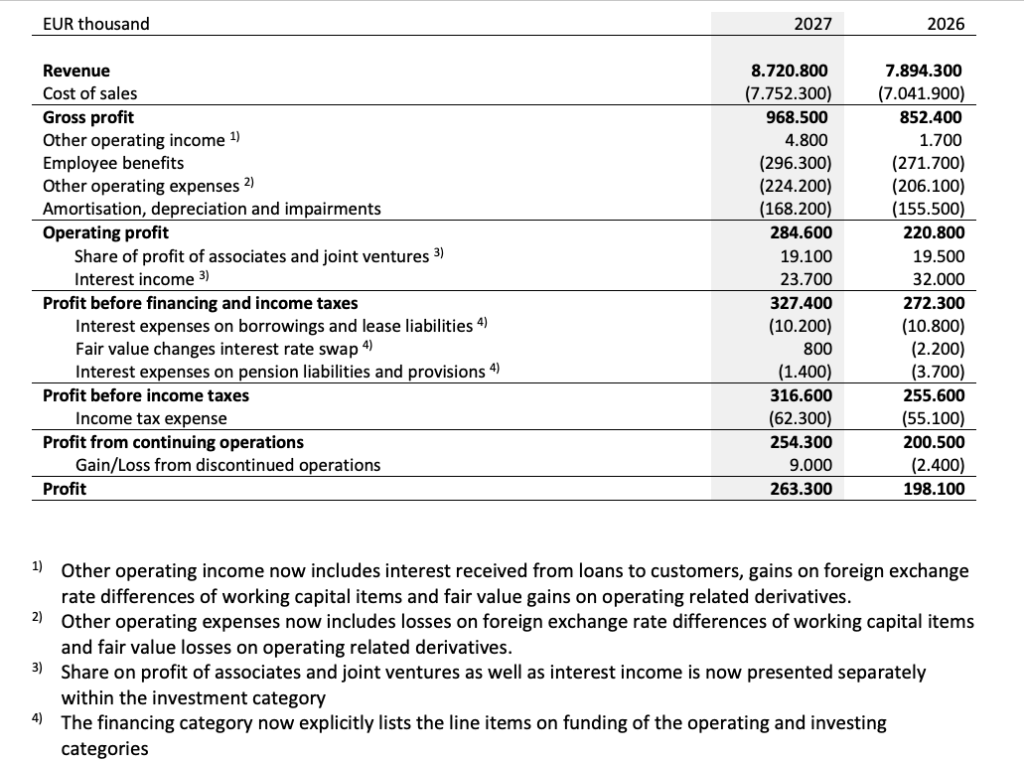
- Operating profit or loss: all income and expenses classified in the operating category
- Profit or loss before financing and income taxes: adding income and expenses classified in the investing category to operating profit or loss
- Profit or loss: the total of income less expenses being the total of all five categories
In addition, you are required to present in the profit or loss: revenue, operating expenses, share in result of associates and joint ventures, income tax expense and the result on discontinued operations.
As for operating expenses, it is required to present the expenses in line items that provide a structured summary either based on their nature of function or both. When expenses are presented by function in the profit or loss an additional disclosure is required on the expense by nature, including depreciation, amortisation, employee benefits, impairment losses and inventory write-downs.
Here is what your statement for profit or loss may look like in practice:
C. Presentation changes
There are two key changes in the presentation of the financial statements:
- Balance Sheet: goodwill is presented as a single line item on the balance sheet.
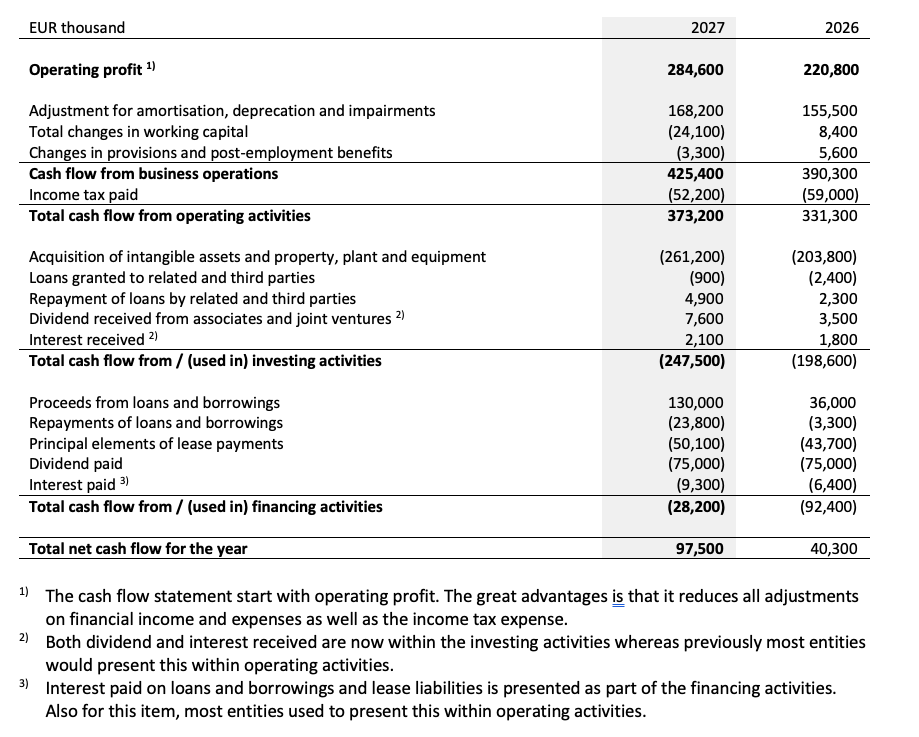
- Cash flow statement: the indirect method starts from operating profit or loss. Interest paid and dividends paid are presented as financing activities; interest received and dividends received are presented as investing activities.
Here is what your statement of cash flows may look like in practice:
D. Management-defined Performance Measures (MPM)
Management-defined Performance Measures (MPM) are subtotals of income and expenses used by your company in public communications. These are in essence your adjusted or non-GAAP figures and will now become part of the financial statements.
That has real consequences: MPMs now fall within audit scope. Every MPM requires a note that explains why management considers it useful, shows how it is calculated, and provides a reconciliation to the closest IFRS measure.
Getting internal alignment on your MPMs takes more time than most teams expect. This is an area worth starting early. Here is what an MPM disclosure may look like in practice:
EBITDA:
The Group uses EBITDA as a key performance measure to assess the underlying operating performance of the business. Management believes EBITDA provides useful information to investors because it facilitates comparison of operating performance between periods by excluding items not considered indicative of the Group’s core operating activities, including financing, taxation, depreciation and amortisation.
The Group defines EBITDA as operating profit before:
- depreciation of property, plant and equipment;
- amortisation of intangible assets; and
- impairment losses on non-financial assets.
The most directly comparable IFRS measure is operating profit:

IFRS 18 IMPLEMENTATION IN PRACTICE
To comply with the new standard, most companies will need to reclassify accounts in their chart of accounts and create some new ones. In particular companies that use derivatives will need new balance sheet accounts (or dimensions). Companies that do not have derivatives are usually unaffected there.
The income statement changes are more significant. Most companies restructure their chart of accounts to make the three categories explicit. In concrete terms:
- Operating: foreign exchange gain/loss accounts are added, interest on loans to customers moves here from financial income, and companies using derivatives add accounts per hedge type.
- Investing: interest income on bank accounts and debt securities, dividend income and fair value changes on securities are separated from financing. Foreign exchange and derivative accounts are added per category.
- Financing: what remains after the moves above: foreign exchange gains/losses, hedge derivative results, and (for some companies) dedicated accounts for interest on borrowings, leases and provisions.
IMPLEMENTATION PLANNING
IFRS 18 touches three areas simultaneously:
-
Processes: transactions must be captured at the right level of detail, consistently;
-
Systems: the chart of accounts and reports need updating; and
-
People: stakeholders need to understand the new presentation and internal alignment on MPM is essential.
With the standard effective from 2027 and prior-year comparatives required, the practical starting point is now as you are required to gather and disclosure more information. Companies that wait may find themselves under significant time pressure.
HOW FIDUGIUS ASSISTS
with practical guidance and support
One of the biggest risks in an implementation like this is that knowledge about the new standard remains concentrated within a small group of specialists. The project team members who conducted the impact analysis and made the key decisions are not always the same people who process transactions daily or submitinformation.
Fidugius is in close contact with clients throughout their IFRS 18 preparation. We support the technical work, but also the communication to the broader finance community, through the Accounting & Reporting Manual.
This means:
- Corporate and local finance teams are well informed and work with the same definitions and instructions from day one; and
- Changes are implemented centrally and immediately visible to all users.
WANT TO LEARN MORE?
Interested in how Fidugius can support your organisation in preparing for IFRS 18? Get in touch or see how our experts can assist your and the Accounting & Reporting Manual works in practice.
Want to stay up to date? Follow us on Linkedin.
When does IFRS 18 become effective?
IFRS 18 is effective for annual reporting periods beginning on or after 1 January 2027, with earlier application permitted. Because prior-year comparatives are required, companies effectively need 2026 figures ready under the new presentation, making 2026 the real preparation deadline, not 2027.
What does IFRS 18 replace?
IFRS 18 replaces IAS 1 Presentation of Financial Statements, but only partially. It focuses specifically on the statement of profit or loss, introducing new categories, mandatory subtotals and additional disclosures, while other aspects of IAS 1 remain in place.
What are the five categories in the IFRS 18 income statement?
IFRS 18 introduces five mandatory categories for classifying income and expenses: Operating, Investing, Financing, Income taxes, and Discontinued operations. Every line in the profit or loss must be classified into one of these, replacing the more flexible presentation allowed under IAS 1.
What subtotals does IFRS 18 require in the profit or loss?
Three subtotals become mandatory: operating profit or loss, profit or loss before financing and income taxes, and profit or loss. Companies must also separately present revenue, operating expenses, share of results of associates and joint ventures, income tax expense, and results from discontinued operations.
What is a Management-defined Performance Measure (MPM) under IFRS 18?
An MPM is a subtotal of income and expenses — often referred to as adjusted or non-GAAP figures like adjusted EBITDA — that management uses in public communications. Under IFRS 18, MPMs must be disclosed in the financial statements with a note explaining their usefulness, calculation method, and reconciliation to the nearest IFRS measure. This also brings MPMs into audit scope for the first time.
How does IFRS 18 change the cash flow statement?
The indirect method must now start from operating profit or loss instead of profit before tax. Interest paid and dividends paid move to financing activities, while interest received and dividends received move to investing activities. This is a shift from how most entities currently present these items under operating activities.
Does IFRS 18 require changes to the chart of accounts?
Yes, for most companies. Income statement accounts typically need to be restructured to make the operating, investing and financing categories explicit — for example, splitting out foreign exchange results and interest income by category. Companies without derivatives or investment activities generally see limited impact on the balance sheet.
How can companies prepare for IFRS 18 in practice?
IFRS 18 implementation touches three areas at once: processes (capturing transactions at the right level of detail), systems (updating the chart of accounts and reports), and people (aligning stakeholders on presentation changes and MPM definitions). Given the need for 2026 comparatives, starting the impact assessment now, rather than waiting until closer to 2027, avoids time pressure later.
