
As organisations grow, financial reporting becomes harder to manage. New accounting policies are introduced, reporting requirements expand, and finance teams across entities and countries must apply the same rules consistently.
But in many organisations, the guidance behind financial reporting is scattered across documents, spreadsheets, email threads and internal knowledge.
Over time, reporting becomes dependent on individual expertise instead of structured knowledge. The result?
- Different interpretations of accounting policies
- Repeated questions from subsidiaries
- Time-consuming review processes
- Corrections during closing
- Increasing pressure on Group Finance teams
A STRUCTURED ACCOUNTING & REPORTING MANUAL
The Fidugius Financial Accounting & Reporting Manual centralises your entire accounting and reporting framework in one structured and accessible platform. It provides finance teams across the organisation with clear, practical guidance for recording and reporting transactions consistently.
Everyone works from the same principles, the same definitions and the same documentation. No more searching through policies, PDFs or outdated documents.
The Fidugius platform brings together the key building blocks of your financial reporting framework.
ACCOUNTING POLICIES:Clear documentation of accounting principles for recognition and measurement based on applicable accounting standards. Example: recognition and measurement of provisions.
ACCOUNTING TREATMENTS: Practical guidance on how transactions should be processed in the accounting system. Example: capitalisation and depreciation of a newly acquired machine.
CHART OF ACCOUNTS: Structured documentation of accounts and their intended use within financial reporting. Example: recording revenue from product sales.
SUPPORTING SCHEDULES: Understanding of all the required movements codes, that result in movement schedules and ultimately a cash flow statement, but also information on other additional disclosures. Example: the movement code used when entering into a new (finance) lease.
COST CENTERS: Definition of organisational units used for cost allocation and management reporting. Example: Allocation of software licence costs to the IT department.
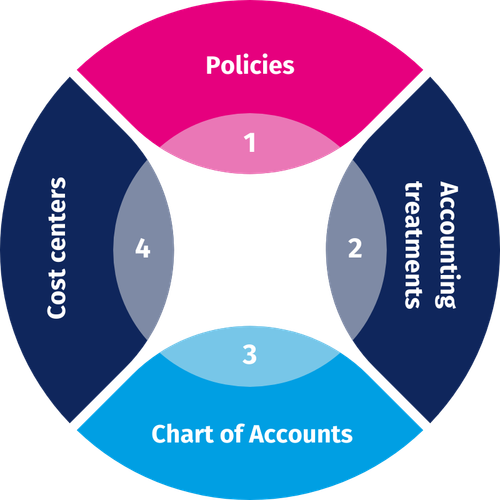
By connecting these elements, the platform creates a complete and consistent reporting framework.
BUILT FOR COMPLEX REPORTING ENVIRONMENTS
The Fidugius Financial Accounting & Reporting Manual is designed for organisations with complex reporting structures, including:
- International groups with multiple entities
- Companies reporting under IFRS or multiple GAAP frameworks
- Organisations with centralised Group Finance functions
- Companies managing large finance teams across locations
The platform ensures that everyone involved in financial reporting works from the same structured knowledge base.
CONFIDENCE IN YOUR NUMBERS
With the Fidugius Financial Accounting & Reporting Manual, organisations achieve:
- Consistent application of accounting policies
- More reliable and comparable reporting
- Fewer corrections during closing
- More efficient audits
- Reduced pressure on Group Finance teams
- Faster onboarding of new finance employees
Most importantly, finance leaders gain confidence in the numbers used for decision-making.

FAST AND RELIABLE REPORTING ON FINANCIAL RESULTS HAS NEVER BEEN EASIER.
FLEXIBLE DEPLOYMENT
The Fidugius Financial Accounting & Reporting Manual is deployed within your own SharePoint tenant and continuously improved based on product development and client feedback, ensuring it it remains modern, scalable and user-friendly.
-
 Lees verder
ISSB
The Trustees of the IFRS Foundation announced the formation of the International Sustainability Standards Board (ISSB) on 3 November 2021,... -
 Lees verder
IASB
The IASB is responsible for the development and publication of IFRS Accounting Standards. The IFRS Accounting Standards provide for a... -
 Lees verder
IFRS Foundation
To ensure information is presented in a consistent and transparent manner, is comparable and enforceable, standards are issued by organisations,... -
 Lees verder
How to ensure reliable ESG reporting?
Listed and large companies are preparing themselves for reliable reporting on environmental, social and governance (ESG) matters following the EU’s... -
 Lees verder
IFRS 18 in practice
IFRS 18 is effective from 1 January 2027, but preparation starts now. IFRS 18 Presentation and Disclosure in Financial Statements...
