A STRUCTURED APPROACH TO CLEAR AND CONSISTENT REPORTING

Creating a clear and workable accounting and reporting framework requires more than documentation alone. It requires structure, alignment and practical application across your organisation.

Fidugius follows a proven, step-by-step approach to translate your policies, processes and requirements into an accessible knowledge environment.
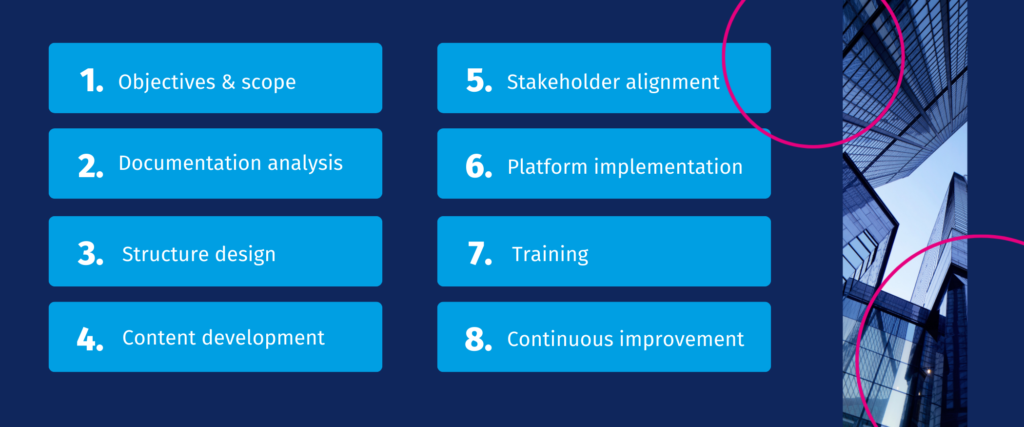

accounting framework steps

1. OBJECTIVES & SCOPE

Every project starts with a clear understanding of your organisation’s objectives. We define:

  • What your reporting framework needs to achieve
  • Which entities, processes and frameworks are in scope
  • Key challenges in your current reporting environment

This ensures that the solution aligns with your organisation’s priorities from the start.

3. STRUCTURE DESIGN

A strong structure is essential for usability. Together with your team, we design a clear and logical structure that connects policies, processes, accounts and reporting requirements.

Through workshops and practical examples, we ensure that the structure reflects how your organisation actually works.

2. DOCUMENTATION ANALYSIS

Most organisations already have a significant amount of documentation in place. We collect and assess:

  • Accounting policies
  • Reporting guidelines
  • ESG documentation
  • Process descriptions

We identify gaps, overlaps and inconsistencies, and determine what is needed to create a complete and consistent framework.

4. CONTENT DEVELOPMENT

Depending on your organisation, we either support your internal experts or actively help draft the content. We focus on making content clear, practical and supported by real-life examples.

This includes accounting policies, ESG guidelines, booking instructions, definitions and methodologies.

Our experience across industries allows us to provide benchmarks and best practices where needed.

5. STAKEHOLDER ALIGNMENT

To ensure adoption across the organisation, alignment is key. We involve:

  • Finance and ESG team
  • Local entities and business units
  • IT and communication departments

A review group validates the content and ensures that all perspectives are included and that the framework works in practice.

6. PLATFORM IMPLEMENTATION

Once the structure and content are defined, we implement the solution within your environment. We:

  • Configure the Fidugius platform (e.g. within SharePoint)
  • Apply your branding and structure
  • Integrate content into a clear, searchable environment

The result is one central platform where users can easily find and understand reporting guidance.

7. TRAINING

A successful implementation does not end at go-live. We train key users to:

  • Maintain and update content
  • Manage the structure
  • Ensure ongoing quality and relevance

This ensures that the platform remains a living knowledge environment.

8. CONTINUOUS IMPROVEMENT

Reporting requirements and regulations continue to evolve. Fidugius supports ongoing development by:

  • Updating content based on new regulations
  • Incorporating user feedback
  • Improving structure and usability

This ensures your framework remains relevant, consistent and future-proof.

FAST AND RELIABLE REPORTING HAS NEVER BEEN EASIER

FLEXIBLE SUPPORT

Every organisation is different. Some clients have strong internal expertise in financial or ESG reporting. Others require more hands-on support. Fidugius adapts accordingly:

  • Supporting internal teams with structure and guidance
  • Co-developing content together
  • Fully assisting in drafting policies and processes

Our experience includes IFRS transitions, ERP implementations, chart of accounts design and optimisation of financial closing processes.

THE RESULT

A clear, structured and practical framework that enables:

  • Consistent application of policies
  • Reliable and comparable reporting
  • Reduced workload for Group Finance
  • Stronger governance and compliance
  • Sustainable knowledge retention

    Sign up for a demo!

    ×

      Learn more Request a brochure

      ×