

A Single Source of Truth (SSOT) needs more than one source of data. It also requires a Single Source of Knowledge (SSOK): the group policies, definitions and instructions that determine how figures are prepared and reported. That distinction between data and knowledge was the starting point of our previous article on single source of truth in finance; this article looks at how the SSOK itself is kept accurate, practical and trusted once it exists.
WHY A SSOK STARTS LOSING VALUE AS SOON AS ITS PUBLISHED
Everything around a SSOK is in motion: business models evolve, acquisitions occur, processes and systems change, and accounting and reporting requirements are renewed. Meanwhile, the people who built the SSOK move on to new projects, and Group Finance stays focused on closing and reporting deadlines. So maintenance is the first thing to slip.
Without an explicit maintenance process, the knowledge base gradually becomes a historical record rather than a reliable source of guidance. Users then create workarounds, retain answers in personal inboxes or rely on local interpretations. The organisation may still have one manual, but it no longer has one dependable source of knowledge.
We saw this play out closely with an international food producer that had just completed its transition from Dutch GAAP to IFRS. The conversion was successful, staff was trained and group wide policies and procedures were introduced. Within months, interpretation had already started to drift between reporting entities and Group Finance was fielding the same questions on repeat and making adjustment to submissions.
WHY SSOK GOVERNANCE REQUIRES BOTH CORPORATE AND LOCAL OWNERSHIP
Overall ownership normally sits with a corporate team such as Group Finance. Corporate has visibility of developments including:
- new or amended accounting policies and disclosure requirements;
- acquisitions and new group-wide activities;
- group audit findings and technical accounting position papers; and
- questions about the application of group reporting requirements.
However, corporate teams often lack both time and detailed visibility of local operations. They may only discover a gap when a reporting entity, auditor or other stakeholder raises a question.
Local reporting entities are therefore not just users. They are contributors and sensors. They are often the first to encounter new transactions, changes in operational processes, local regulatory requirements, impractical instructions or situations not covered by existing guidance.
This does not mean that every local practice should become group policy. Corporate must assess whether an issue is entity-specific, relevant to several comparable entities or applicable across the group. In this assessment Corporate should reach out to representatives of each (major) reporting entity to discuss the potential change. The SSOK should also distinguish clearly between group reporting policy, local statutory requirements and any reconciliation between them.
HOW TO TURN INDIVIDUAL QUESTIONS INTO GROUP-WIDE KNOWLEDGE
Questions arrive through email, closing calls, auditors, Teams messages and individual meetings. Solving the immediate issue is necessary, but it is not sufficient. If the conclusion stays with the people involved, another entity may ask the same question, or reach a different answer.
A QUESTION IS NOT FULLY RESOLVED UNTIL IT HAS BEEN ASSESSED FOR INCLUSION IN THE SSOK.
Each material question or development should lead to one of four outcomes:
| OUTCOME | REQUIRED ACTION |
| Guidance is missing | Add controlled new content. |
| Guidance is unclear | Clarify the existing content or add an example. |
| Guidance already answers the question | Improve searchability, communication or training. |
| The matter is entity-specific | Record the decision and rationale, but do not overload the group SSOK. |
THE SSOK LIFECYCLE
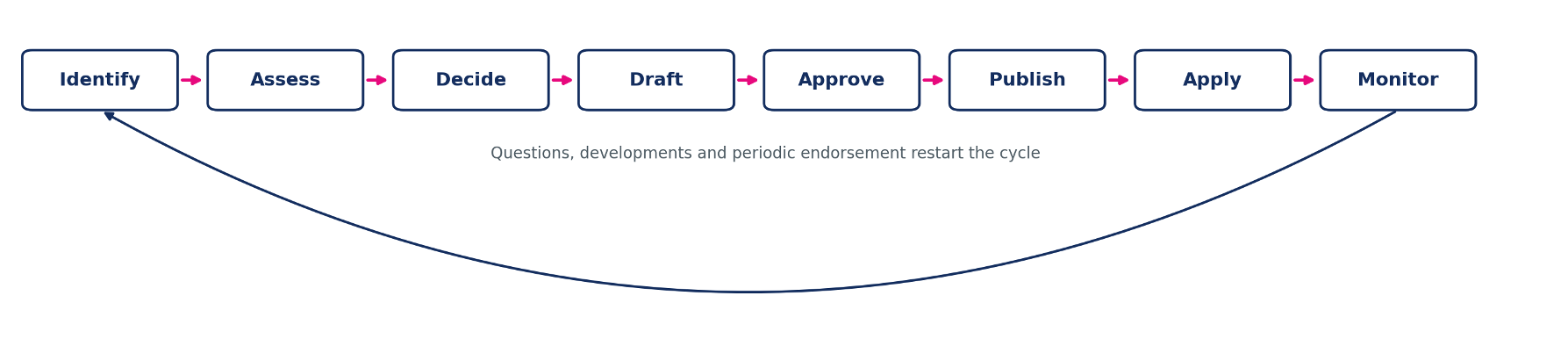
Maintenance should be a continuous cycle rather than an occasional clean-up project. Questions and developments enter the same controlled process as scheduled reviews of existing content.
A practical lifecycle for change-driven maintenance and periodic endorsement:
OWNERSHIP SHOULD BE PROPORTIONAL TO THE CHANGE
Not every change requires a formal approval. It is important to make a distinction in the type of changes and the way the changes are updated and published.
CHANGE |
EXAMPLE |
APPROVAL |
| Editorial | Wording, incorrect reference or formatting within a policy | Content owner |
| Clarification | Explanation or an example without a policy change | Subject-matter owner |
| Policy change | New or amended accounting or reporting policies and treatments | Formal approval by both local and corporate representatives. |
MAINTENANCE ALSO MEANS ENDORSING WHAT HASN’T CHANGED
Not all outdated content announces itself through a question or a new standard. Guidance may remain untouched simply because a transaction occurs infrequently, the original subject-matter expert has left or users have stopped relying on it.
The SSOK should therefore include periodic content endorsement. On a defined cycle, the named owner confirms that the guidance remains accurate, complete, applicable and aligned with current processes, even when no amendment is required. The review date, reviewer and conclusion should be recorded. High-risk accounting policies may require annual endorsement, while lower-risk operational instructions can follow a longer cycle.
This provides evidence that unchanged content has been considered rather than forgotten. It also creates a manageable review calendar instead of a large, irregular clean-up exercise.
HOW TO SET UP SSOK GOVERNANCE IN YOUR ORGANISATION
Some groups use a quarterly committee with corporate and local representatives. Others can maintain the SSOK through an existing controller forum and a short monthly review. The model should reflect the size, complexity and risk profile of the organisation.It is recommended to have quarterly reviews at a minimum and now await the (semi) annual closing process to do the maintenance.
At a minimum, we would expect to see:
- a clear corporate owner for the overall SSOK and named owners for individual content areas;
- local subject-matter contributors who represent the practical user perspective;
- one accessible channel for questions and proposed changes, with visible follow-up;
- a central decision log, including entity-specific conclusions that do not enter the SSOK;
- defined approval levels, version history and effective dates;
- a recurring review of open questions, recurring issues and content due for endorsement; and
- targeted communication explaining what changed, why, when it becomes effective and who must act.
Local participation also needs to be worthwhile. Feedback should be easy to submit in the context of the relevant guidance, contributors should be able to see what happened to their input, and corporate should respond within a reasonable period. Two-way governance works when providing feedback is easier than working around unclear guidance.
HOW TO PRIORITISE SSOK MAINTENANCE
Corporate will rarely have capacity to address every point immediately. Items can be prioritised according to their financial-statement impact, the number of entities affected, the risk of inconsistent accounting, audit or regulatory relevance, urgency for the next close and the frequency with which the question recurs.
High-risk or close-critical matters may require an immediate update. Normal clarifications can be handled in a monthly maintenance cycle, broader improvements in a quarterly review and formal endorsement according to the review calendar.
HOW DO YOU KNOW THE PROCESS IS WORKING?
Measurement should remain proportionate. A smaller organisation does not need a complex dashboard. It can start by reviewing open questions, overdue endorsements and recurring issues during an existing monthly meeting. More mature organisations may also monitor:
- the number and age of unresolved questions;
- the time between a decision and the corresponding SSOK update;
- content that has passed its review or endorsement date;
- recurring questions on topics already covered; and
- audit findings or reporting adjustments linked to unclear or missing guidance.
The objective is not measurement for its own sake. These indicators show where the governance process is not converting experience into reliable group knowledge.
FROM MAINTAINED CONTENT TO A STRONGER CONTROL ENVIRONMENT
A Single Source of Knowledge cannot be maintained by Group Finance in isolation. Corporate must retain ownership of group policy, while local entities need an accessible way to contribute the practical knowledge gained from applying it. At the same time, existing content must be periodically endorsed, including when no change has been proposed.
The result is not simply a better manual. It is fewer repeated questions, more consistent accounting, faster reporting decisions and a stronger financial reporting control environment.
HOW FIDUGIUS CAN HELP
Fidugius provides customers with an Accounting & Reporting Manual that supports this maintenance lifecycle. Users can provide feedback directly on the relevant content, from a simple endorsement to identifying a possible misinterpretation or requesting clarification. This keeps feedback connected to the guidance it concerns and makes local users an active part of SSOK maintenance.
Content owners can use that feedback to assess, update and communicate changes. Users are informed of relevant amendments during the period, while review dates and ownership support the periodic endorsement of existing content. In this way, individual questions and practical experience can become controlled, reusable knowledge for the wider organisation.
Who should own the SSOK?
Overall ownership normally lies with a corporate team such as Group Finance, with named owners for individual content areas. Local reporting entities are contributors rather than just users, they are often the first to spot gaps, impractical instructions or situations the existing guidance does not cover.
How often should SSOK content be reviewed?
This depends on the associated risk. High-risk accounting policies typically require annual endorsement, while lower-risk operational instructions can follow a longer cycle. The review date, reviewer and conclusion should always be recorded, even when no change is made.
What happens to questions that only apply to one entity?
Not every local issue should become group policy. Corporate assesses whether a question is entity-specific or relevant across the group. Entity-specific conclusions are recorded in a decision log, kept separate from the group SSOK so it does not become overloaded with content that does not apply broadly.
