
As organisations grow, financial reporting becomes harder to manage. New accounting policies are introduced, reporting requirements expand, and finance teams across entities and countries need to apply the same rules consistently.
An accounting and reporting manual brings that guidance together in one place. Instead of policies, procedures and definitions being scattered across documents, spreadsheets and individual knowledge, everything is centralised, structured and kept up to date. This way, finance teams always know where to find the right answer.
A well-built manual isn’t just documentation. It connects the policy itself to how it should be applied: the relevant accounts, the booking procedure, and a practical example. That combination is what makes it usable in daily practice, not just technically correct.
WHAT DOES AN ACCOUNTING MANUAL CONTAIN?
A complete manual typically brings together four core building blocks:
ACCOUNTING POLICIES: Clear documentation of accounting principles and measurement rules, based on the applicable accounting standards (IFRS, local GAAP, or a combination across entities).
ACCOUNTING TREATMENTS: Practical guidance on how specific transactions and balances should be processed in the accounting system. The step between “what the policy says” and “what you actually book.”
CHART OF ACCOUNTS: Structured documentation of accounts and their intended use, so the same transaction is recorded the same way across entities and teams.
COST CENTERS: Definition of the organisational units used for cost allocation and management reporting, including which costs belong where and why.
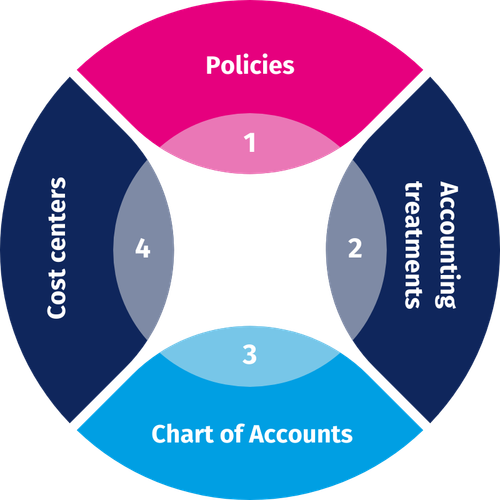
What makes these four elements powerful is not that they exist separately, but that they’re cross-referenced. A user reading an accounting policy can navigate directly to the related booking procedure or chart of accounts entry, and back again. That’s what turns a set of documents into a living knowledge environment.
WHO NEEDS AN ACCOUNTING MANUAL?
Organisations typically start looking for a structured manual in a few recognisable situations:
- After an accounting transition, for example from Dutch GAAP to IFRS. In these cases, policies have been defined, but knowledge of how to apply them hasn’t yet reached daily practice.
- After international acquisitions, when multiple entities each continue working with their own local accounting practices, making group reporting difficult to compare.
- When a technically correct but overly complex policy document exists, often delivered by an accounting firm, that is rarely used because it wasn’t built for daily application.
- As reporting complexity grows — more entities, more regulation, more reporting lines, and Group Finance is increasingly the bottleneck for interpretation questions.
In all of these cases, the underlying issue is the same: the knowledge exists, but it isn’t structured, accessible or consistently applied.
WHY FIDUGIUS BUILT AN ACCOUNTING & REPORTING MANUAL
The idea goes back to the early 2000s. While working at Ahold, our founder Matthijs Dijkema got the opportunity to develop an online Accounting & Reporting Manual, quite progressive for its time. What fascinated him wasn’t the technology itself, but the effect: when everyone works from the same principles, the same definitions and the same way of working, things calm down. Less interpretation. Fewer discussions. Reporting you can rely on.
From 2005, working as an interim finance professional across different organisations, he kept hearing the same question: “How do we make sure our whole finance community works the same way, using the same information?” That question is what led to founding Fidugius.
What still drives the team today is that the solution goes far beyond a digital handbook. Clients tell us it saves time in preparing, compiling and analysing reports. That reporting quality improves. That knowledge is retained, even when people leave.
That same idea: one place, one set of definitions, applied consistently, is what our Financial Accounting Manual & ESG Reporting Manual are built on today.

IN-HOUSE SOLUTIONS VS. AN INTERACTIVE MANUAL
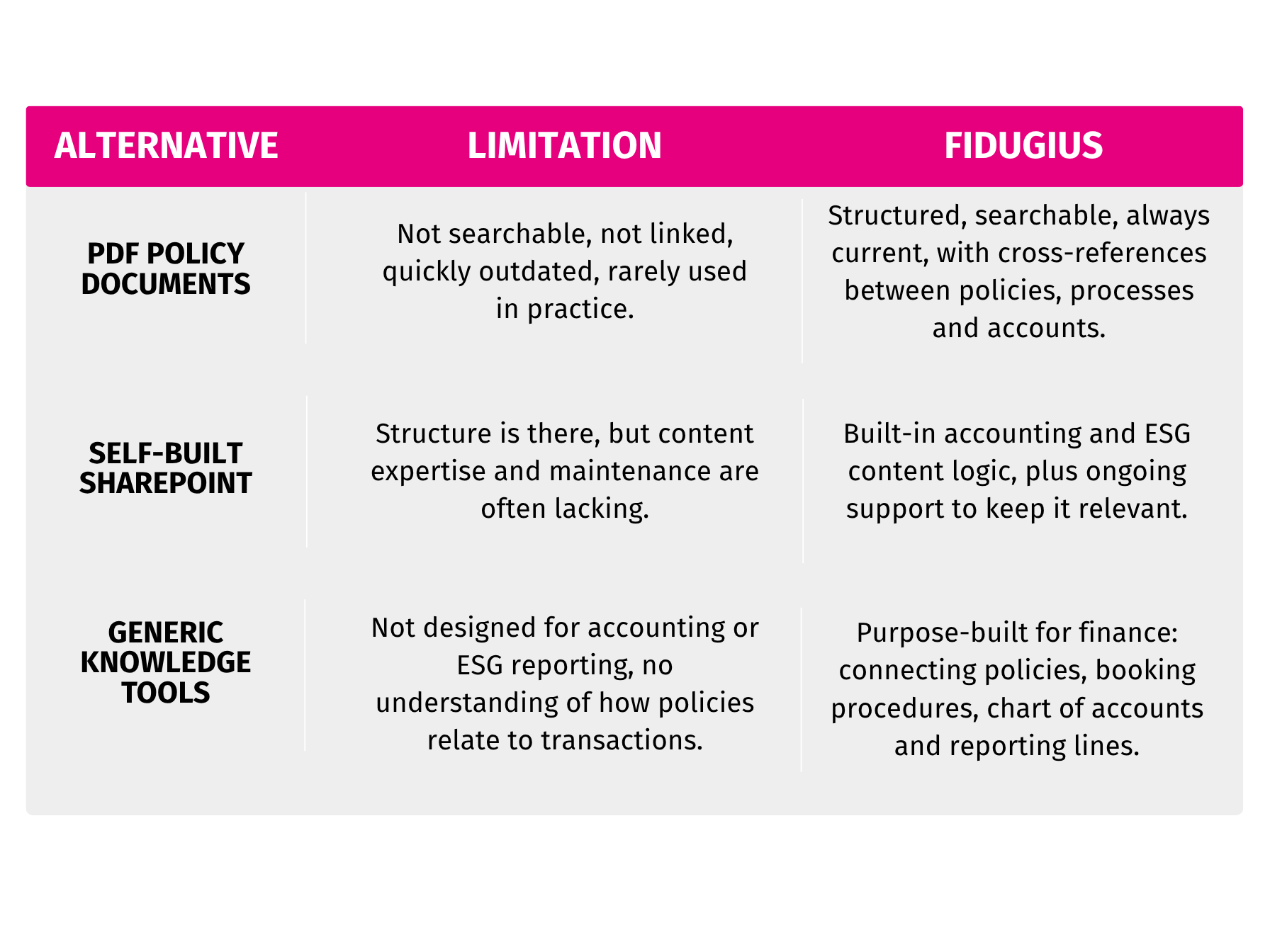
Many organisations already have some form of documentation in place. The question we hear most often: can we not build this ourselves? Here’s how a dedicated manual compares to the common alternatives:
OUR APPROACH: FROM DOCUMENTATION TO DAILY PRACTICE
Building a manual that’s actually used requires more than writing down policies. Fidugius follows a proven, eight-step approach:
Objectives & scope — define what the framework needs to achieve, which entities and processes are in scope, and what the key challenges are.
Documentation analysis — collect and assess existing policies, guidelines and documentation; identify gaps, overlaps and inconsistencies.
Structure design — design a clear, logical structure that connects policies, processes, accounts and reporting, reflecting how the organisation actually works.
Content development — rewrite or co-develop content in clear, practical language, supported by real-life examples and booking instructions.
Stakeholder alignment — involve finance, IT and local entities to validate content and ensure practical adoption.
Platform implementation — configure the platform, apply your branding, and integrate all content into a searchable knowledge hub.
Training — train key users to maintain and update content independently.
Continuous improvement — update content based on new regulations, user feedback and evolving requirements.
Some organisations have strong internal expertise and need mainly structure and guidance. Others prefer a more hands-on partnership. The approach adapts to your situation.
CLIENT CASES

From a 400-page IFRS policy to a practical Accounting & Reporting Manual
With the support of a major accounting firm, an international oil and gas company had developed a comprehensive IFRS policy...

From Dutch GAAP to IFRS: turning a complex transition into consistent group reporting
An international producer of meat and plant-based products had recently transitioned from Dutch GAAP to IFRS. The technical conversion itself...

Creating a unified accounting framework for a buy and build organisation
An international distributor of life science ingredients experienced rapid growth through a series of acquisitions. While the newly acquired entities...
READ MORE
FAQ
What is included in an accounting manual?
A good accounting manual goes beyond a static policy document. It typically brings together accounting policies, accounting treatments, chart of accounts and cost centers.
What's the difference between an accounting manual and an accounting policy document?
A policy document describes the rules. An accounting and reporting manual goes further: it connects those rules to the accounts, processes and transaction examples needed to actually apply them, and keeps that connection up to date as things change.
What organisations need an accounting manual?
An accounting manual becomes essential once financial reporting outgrows a single person’s memory or one shared drive. In practice, this usually applies to organisations that operate across multiple entities or locations, work under complex frameworks (such as IFRS, multiple local GAAPs, or a recent transition between the two), have grown through acquisitions or depend on a few key people for knowledge.
What is the added value of an accounting manual?
The real value of an interactive accounting manual, such as Fidugius’ Financial Accounting Manual, comes from how these elements connect: a policy links directly to the relevant booking procedure, GL account and reporting line, so employees don’t just read a rule, they see exactly how to apply it.
